-Overview
Opportunity Zones is a federal tax incentive that encourages long-term investment into disadvantaged census tracts throughout the country. Originally created in 2017, this incentive was made permanent in 2025, making Opportunity Zones one of the newest development finance tools for communities to use throughout the country.
With Opportunity Zones now permanent, new regulations, guidance, and investment data are shaping the program’s next phase. Lessons from the first round of Opportunity Zone projects provide critical insight into how this updated tax incentive will influence investment and community development over the next decade.
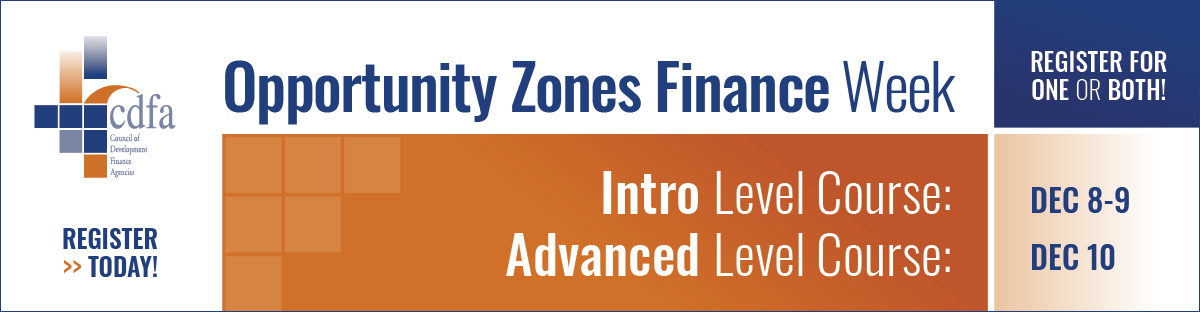
The Advanced Opportunity Zones Finance Course brings together program designers, fund managers, community leaders, investors, and policy experts to share strategies for attracting zone investments and maximizing Opportunity Zones 2.0. The course also covers key legislative updates, including enhanced bonus depreciation provisions, new zone designations with an emphasis on rural areas, and other critical policy developments.
This course is presented in partnership with Grow America.
This course qualifies for the CDFA Training Institute's Development Finance Certified Professional (DFCP) Program. Join us online to advance your expertise and enhance your professional development.
Register
Course Objectives
- Analyze effective capital and marketing strategies
- Examine best practices for aligning community priorities and resources with QOF criteria
- Understand how fund managers evaluate and structure projects for fund review
- Evaluate strategies for cultivating stakeholder and investor ecosystems
- Walk through the management of a successful OZ project throughout the incentive's lifecycle
- Understand how to incorporate OZs into existing project capital stacks
- Explore how Opportunity Zone investment can be implemented across various industries
|
Topics Covered
- Project planning, marketing, and execution
- Qualified Opportunity Fund structures
- Fund assessment
- Investor and stakeholder cultivation
- Management, monitoring, and reporting strategies
- Qualified Opportunity Zone Business models
- Capital stack strategies
|
Who Should Attend?
- Fund managers
- Local, regional, and state developers
- Tax professionals
- Economic development practitioners
- Community development professionals and P3 practitioners
- Brokers, dealers, underwriters, and elected officials
- Government and nonprofit finance officers
- Attorneys, accountants, and financial advisors
|
-Agenda
Thursday, December 10, 2026
| Thu 11:00 AM - 11:10 AM |
Welcome & Overview
Welcome to the course! This session will introduce CDFA, explain how to use the online software, and discuss the framework for the Advanced Opportunity Zones Finance Course.
|
| Thu 11:10 AM - 12:00 PM |
Capital Strategy in Opportunity Zones: From Prospectus to Execution
The Opportunity Zone prospectus is only one piece of a campaign to attract investment. The process of planning, prioritization, and aligning public resources requires a larger marketing and capital strategy framework. Participants will examine lessons from OZ 1.0, define the elements and role of a prospectus within a larger strategy, and assess how investor timelines and the overlap of OZ 1.0/2.0 influence capital deployment decisions.
Speaker(s)
|
| Thu 12:00 PM - 12:50 PM |
|
| Thu 12:50 PM - 1:00 PM |
Break
|
| Thu 1:00 PM - 2:00 PM |
Designing the Opportunity Zone Ecosystem: Urban, Rural & Regional Models
Effective OZ implementation depends on ecosystem design, not tract designation. This session examines how communities structure coordinated strategies across urban, rural, regional, and statewide contexts. Case study examples will highlight stakeholder alignment, rural capacity considerations, and long-term investment pipeline development, including strategies to cultivate a local investor base.
Speaker(s)
|
| Thu 2:00 PM - 2:10 PM |
Break
|
| Thu 2:10 PM - 3:30 PM |
Life Cycle of a Capital Stack
Opportunity Zone transactions rely on carefully layered capital structures that combine tax-advantaged equity with traditional financing tools. This session examines how established deals can incorporate Opportunity Zone equity, debt, and complementary tax incentives. Through private and public examples, participants will walk through the practical steps necessary to manage an Opportunity Zone within a capital stack throughout the incentive's life cycle, including documentation and reporting necessary to meet substantial improvement requirements and maintain compliance.
Speaker(s)
|
| Thu 3:30 PM - 4:55 PM |
Expanding Opportunity Zones: Transactions Across Sectors
While early Opportunity Zone investment focused heavily on housing, the incentive is increasingly supporting a broader range of sectors and project types, including commercial real estate, QOF businesses, renewable energy, healthcare, and mixed-use development. In this session, fund managers and project sponsors explore real transactions that examine how Opportunity Zone capital is being deployed across industries and how projects position themselves to compete for investment.
Speaker(s)
- Jill Homan, Deputy Director, Trade & Economy Policy, and Campaign Director, American First Policy Institute (AFPI)
- Katherine Mize Iriarte, Principal, Arctaris Impact Investors, LLC
|
| Thu 4:55 PM - 5:00 PM |
Closing Discussion / Final Questions
|
|
-Location
The Advanced Opportunity Zones Finance Course will take place on Zoom. The course will meet from 11:00 AM-5:00 PM Eastern. Attendees must have access to a computer and the internet to attend the course. |
-Registration
This training course qualifies for the CDFA Training Institute's
Development Finance Certified Professional (DFCP) Program. Start down the road to personal and professional advancement today.
CDFA Foundation Scholarship Program
Scholarships are available for CDFA Members in need to attend CDFA Training Courses. Learn more about the
CDFA Foundation Scholarship Program and submit your application today.
Please note that the application deadline is two weeks prior to the course start date.
Group Discount
Organizations registering five or more attendees qualify for a group discount. Register four attendees at the full price, and each additional registration receives 50% off. To receive the discount, contact
info@cdfa.net before registering.
CDFA permits only one person to log in and participate in the course. If multiple people are accessing the course without paying to attend, we will terminate the connection and access.
|
CDFA Member: $500
Non-Member: $825
|
CDFA Member: $625
Non-Member: $950
|
Register